

Moving-the-Image through the Social Flesh: Gathering in Difference

2.20–3.40pm
PANEL SESSION
CHAIR: Tristen Harwood, Writer and Lecturer in Critical and Theoretical Studies, VCA
Dr Laresa Kosloff, Artist and Senior Lecturer, RMIT | The paradox of agency
Hayley Millar Baker, Artist | The Indigenous Feminine Body as Universe
Tina Stefanou, Artist and PhD Candidate, VCA | Moving-the-Image through the Social Flesh: Gathering in Difference | Talk and response with a chorus of first-year sculpture students from the VCA.


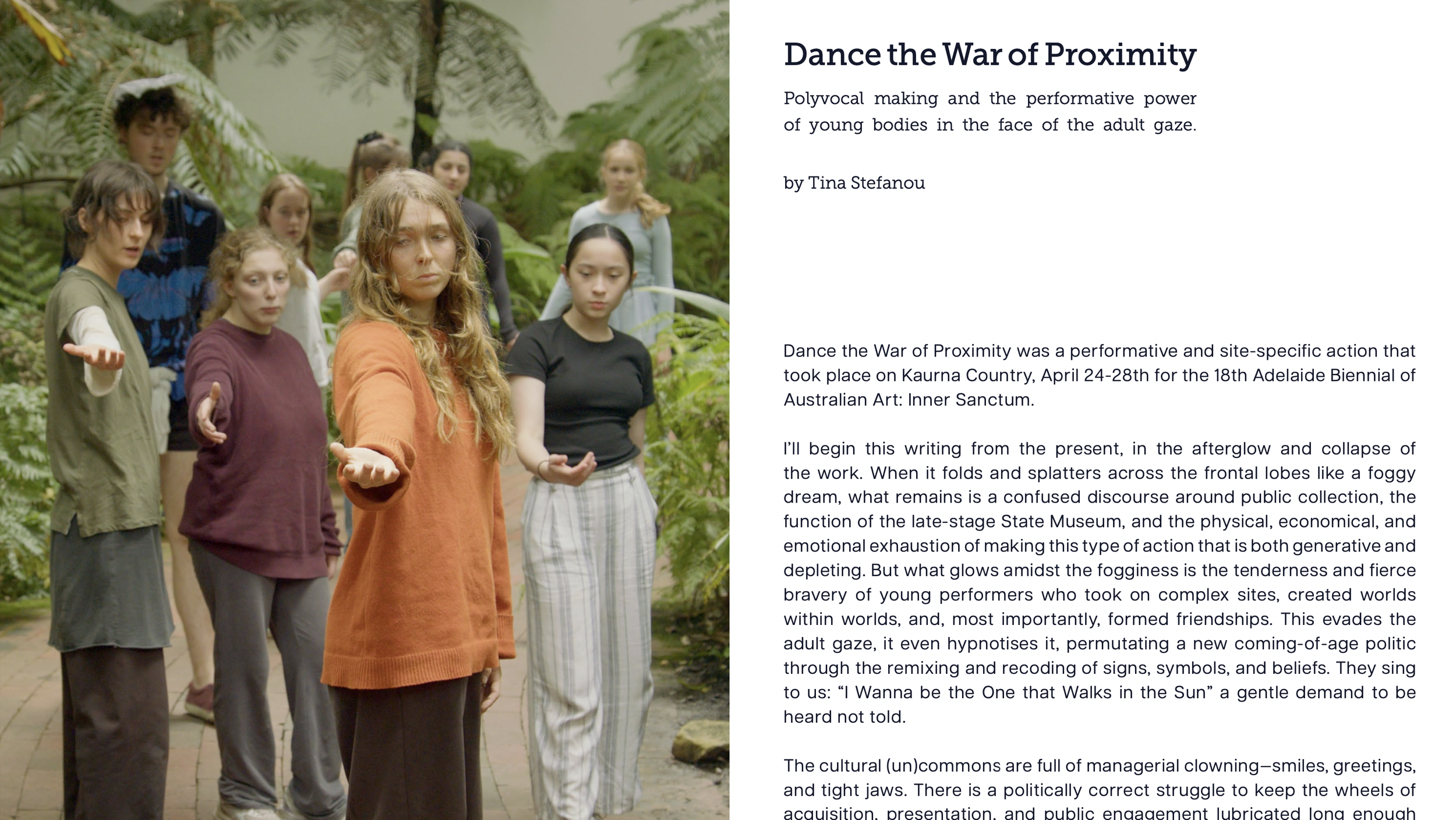


Dance the War of Proximity: workshops
Development and workshops with Adelaide youth performers. Co-facilitated with Lily Potger and Alice Heyward at Estonian Hall in North Adelaide.
Creative producer Jennifer Greer Holmes.
Documentation by Sia Duff


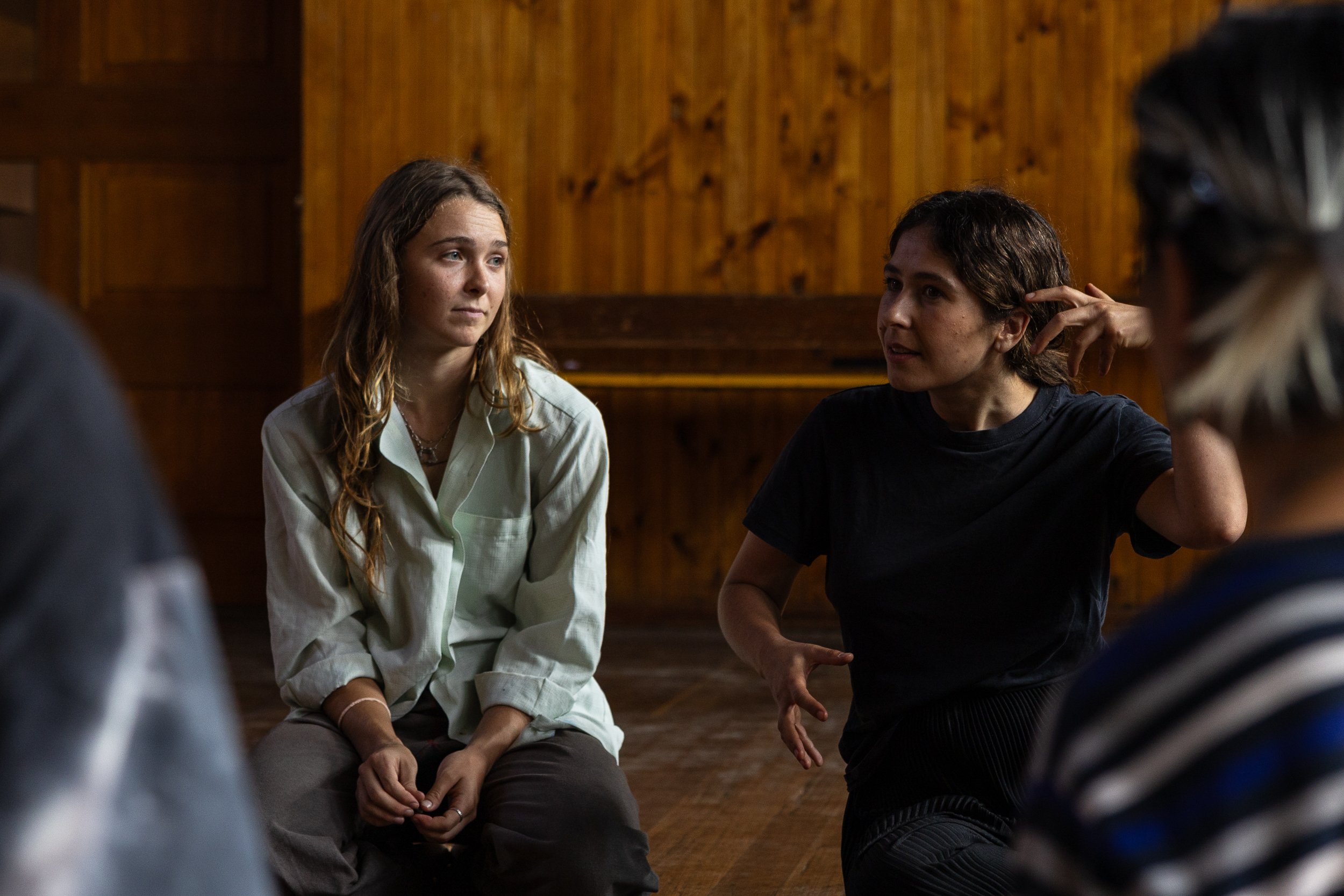


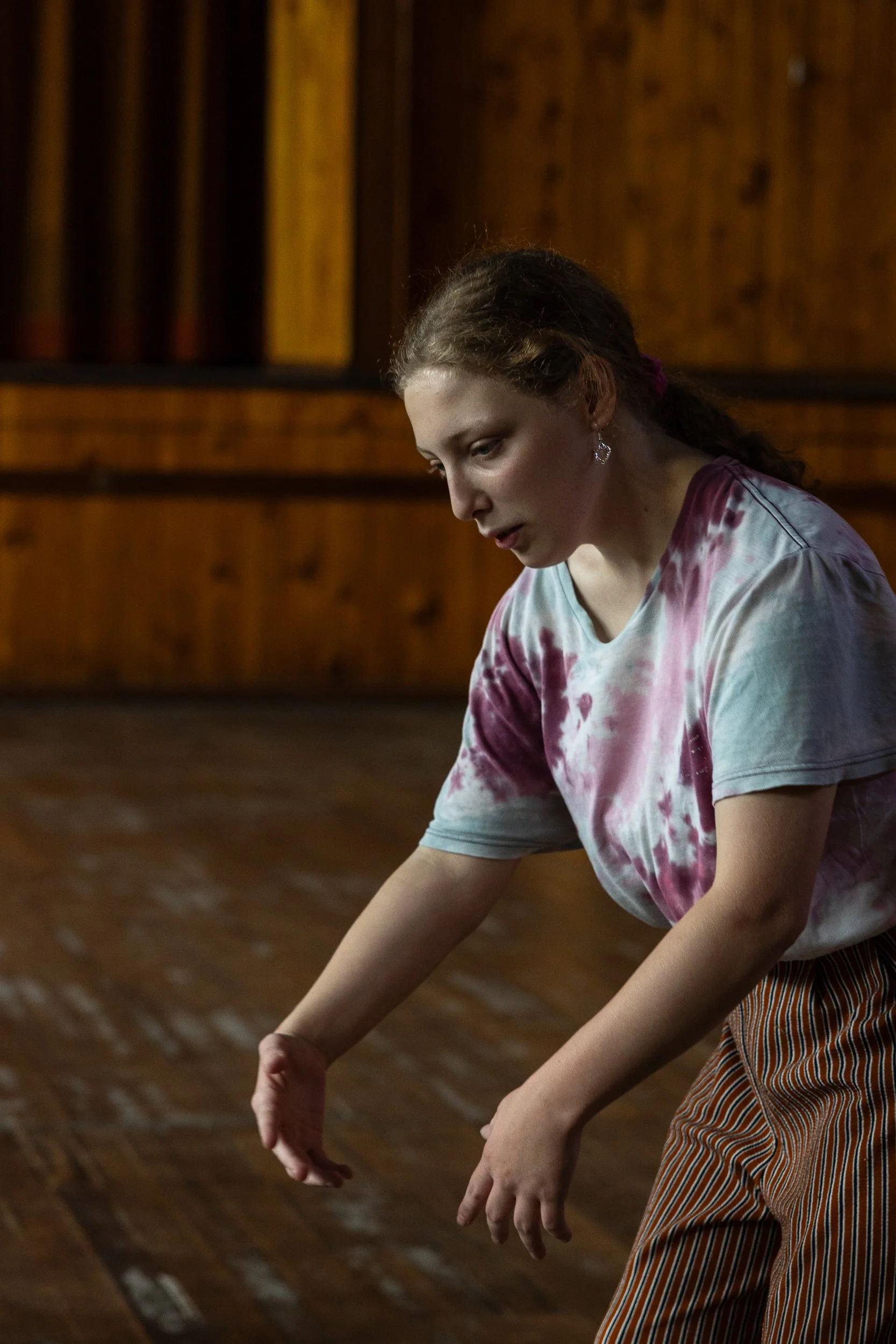


Dance the War Proximity
Dance the War of Proximity, 2024, is a performance action and live filmic event featuring 10 young performers, as part of the 18th Adelaide Biennial of Australian Art: Inner Sanctum. Through embodying a metaphorical nervous system and enacting certain functions, these performers integrate singing, speaking, vocalisation, and movement, drawing inspiration from nature, art, science, and popular culture.
The action serves as a self-organising system, resembling a form of poetic automaton, that moves through different sites of exhibition in Adelaide city, shedding light on various facets of coming-of-age politics. Whether delving into themes of valuation, social class, the sun, puberty, resource distribution, elderhood, or symbiosis, Dance the War of Proximity aims to forge strange solidarities within sites of collection and surveillance (including botanic gardens, zoos, and summits), questioning their historical contexts, the politics of acquisition and the gaze, using the body-voice as an instrument to explore more-than-human and more-than-bourgeoisie modes of making-sensing, which are always commoning through collective labour formations and technologies of improvisation.
This work is an extension of Hym(e)nals, a four channel video and sound work that features the artist's long engagement with a herd of elderly horses and their teenage female horse riders, currently showing in the Adelaide Biennial at AGSA.
The live performances take place across Adelaide at Mount Lofty, Adelaide Botanic Garden, Adelaide Zoo and the Art Gallery of South Australia. Entry is free at all locations except Adelaide Zoo with a 2 for 1 ticket offer* after midday on 27 April using the code word 'BIENNIAL' at the main entrance.
*Valid for entry ticket of equal or lesser value.
Performance details
Wed 24 Apr, 12-1.30pm
Mount Lofty Lookout
Fri 26 Apr, 1-2.30pm
Adelaide Botanic Garden at the Amazon Water Lily Pavilion, Palm House and the Bicentennial Conservatory
Sat 27 Apr, 2-3.30pm
Adelaide Zoo
Sun 28 Apr, 3-4pm
Art Gallery of South Australia in Gallery 13
Credits
Lead artist
Tina Stefanou
Creative producer
Jennifer Greer Holmes
Co-choreography and performers
Lily Potger, Alice Heyward and Celina Hage
Youth ensemble and co-choreography
Victoria Mackay, Kaz Rogers, Cooper Faull, Scarlett Jankowiak, Jade Porter, Maree Fong, Sahara Soliman, Jazmine Deng and Indigo Fossey
Live film documentation
Andrew Kaineder and Wil Normyle
Live sound documentation
Nick Steele
Poster design
Rose Williams
This work was made and witnessed on Kaurna Country.
This project has been assisted by the Australian Government through Creative Australia, its principal arts investment and advisory body.


Rural Utopias 24 November 2023 – 18 February 2024 The Art Gallery of Western Australia

I’ve met your barrel-chested creatures in the fields and witnessed a deer transform as we sang amidst ankle cutting stubble. Emus sprinted across plains, and a powerful poet reminded me that a campfire was all one needed. We spent nine days sewing and laughing as ‘90s pop songs played through our 5,000 kilometres of seed stitching.
Your charm is in simple gestures — smiles, greetings, and stray farm dogs. Light softens your terrain, making even imposing machinery appear gentle. I couldn’t help but think of the film Gladiator and its famous opening grain scene, where pre-violence brings profound stillness.
The water monsters, the Axolotls at the pub, beckon like sirens, reminding me of the possibilities of regeneration even in a muddy tank. In your presence, the anxiety of ambition and agri-art’s careerism waned. I didn’t want to subject you to tokenism or similar contrivances, nor did I aim to romanticise or infantilise. Instead, your vocal totems, the wildflowers in the gaps, were my focus.

Grandmothers Started the Revolution
Photo essay and performative action in Enough is Enough.
Edited by Vikki McInnes
CoVA x Perimeter is a collaborative publishing initiative curated by the Centre of Visual Art at the University of Melbourne and independent publishing house Perimeter Editions. Foregrounding experimental and otherwise innovative discursive outputs from three key streams of enquiry – Postnational Art Histories, Feminism and Intersectionality, and Art + Science – the program spans research-in-progress, academic dialogues, artist responses, and essays, working to reframe scholarly research via a multiplicity of new perspectives and lenses. The Feminism and Intersectionality series explores discourse and practices that challenge dominant narratives and ideologies, proposing new frameworks through which to continue making and legitimising forms of knowledge and cultural production that are otherwise rendered invisible or deemed untenable. The series aims to address relations of difference, heterogeneity, and hierarchy, enriching our understanding of inequality and global power relations and interactions.
This publication was conceived on March 15, 2021, when more than one hundred thousand people marched across Australia in a series of March 4 Justice protests calling for gender equality and justice for victims of sexual assault. While these protests were motivated by anger at the lack of response by the Australian federal government to current and historic rape allegations, they were part a larger global movement that was gathering momentum. Edited by Vikki McInnes and designed by Kim Mumm Hansen, Enough: Artists and writers on gendered violencecomprises creative responses to the issues highlighted in these protests. Responses are subjective, poetic, cathartic, and as fiercely political and deeply personal as the issues they address.
With contributions by: Anjella Roessler, Anna Ricciardi, Claire Bridge, Darcey Bella Arnold, Deborah Eddy, Freda Drakopoulos, Helen Grogan, Iona Mackenzie Cant, Isabelle Sully, Jordan Wood, Josephine Mead, Julie Vinci, June Miskell, Katie Paine, Katie Sfetkidis, Louise R Mayhew, Makeda Duong, Michelle Hamer, Natalie King, Natasha Rai, Nell, Nur Shkembi, Philipa Rothfield, Sandra Minchin-Delohery, Sophia Cai, Tina Stefanou, Wendy Catling, and Zoë Bastin.
224 pages, 22 x 14.5 cm, cold glue bind, softcover with flap, Perimeter Editions x CoVA at the University of Melbourne (Melbourne).


Agripoet(h)ics: What is an artist Suppose to do with all this?
“I am going to share two ongoing projects which consist of films and some fields notes from two different sites and focus on performative co-inventions with communities, animals, and environments living with automated farming practices and technologies and their co-emergence with the art market. The field notes and films act as a call and response to one another, and interrogate the role of the artist-researcher in these spaces.
The initial trilogy of films emerged from sixteen weeks of fieldwork conducted in Carnamah, situated on Amangu country, approximately four hours northeast of Perth. This exploration focused on grain production utilising performance, para-ethnographical practices, and vocal workshops within the Wheal Belt region. The concluding piece, an animation serving as a precursor to a forthcoming series of actions, was born from experiences at the Dookie Agricultural campus and Robotic Dairy Farm in regional Victoria, located on Yorta Yorta country.
I won’t have time to talk through all of the details of the films and their multitudes. This is also the first time that the films from Carnamah have been shown to the public outside of the community. I have no map for these stories and my methodological approach is grounded in the sensorial and relational experience of vocalising with places, animals, machines, and people. Condensing the myriad paradoxes and complexities I encountered during my time into this twenty-min talk is beyond my capacity. Attempting to do so would mean succumbing to a form of writing and expression Michael Taussig terms "agribusiness writing." This type of writing obfuscates the processes of production, operating under the assumption that writing's primary function is to convey information, distinguishing it from writing that embraces attributes such as poverty, humour, failure, loss, luck, drought, animality, fibres, the ecstatic, and more. It erases the page's chaotic and vibrant collaborators, spirits, and tricksters. These cheeky paraontological collaborators and extra affects challenge established power structures inherent in using language not only as a tool for ownership, territorial claims, and careerist individualism. These transindividual forms of language encapsulates what I refer to as 'more-than middle-class+ aesthesis,' embodying a range of intricate vulnerabilities and relational poetics beyond the production of distinct art selves.”
*hum
Going against the grain with artist Tina Stefanou
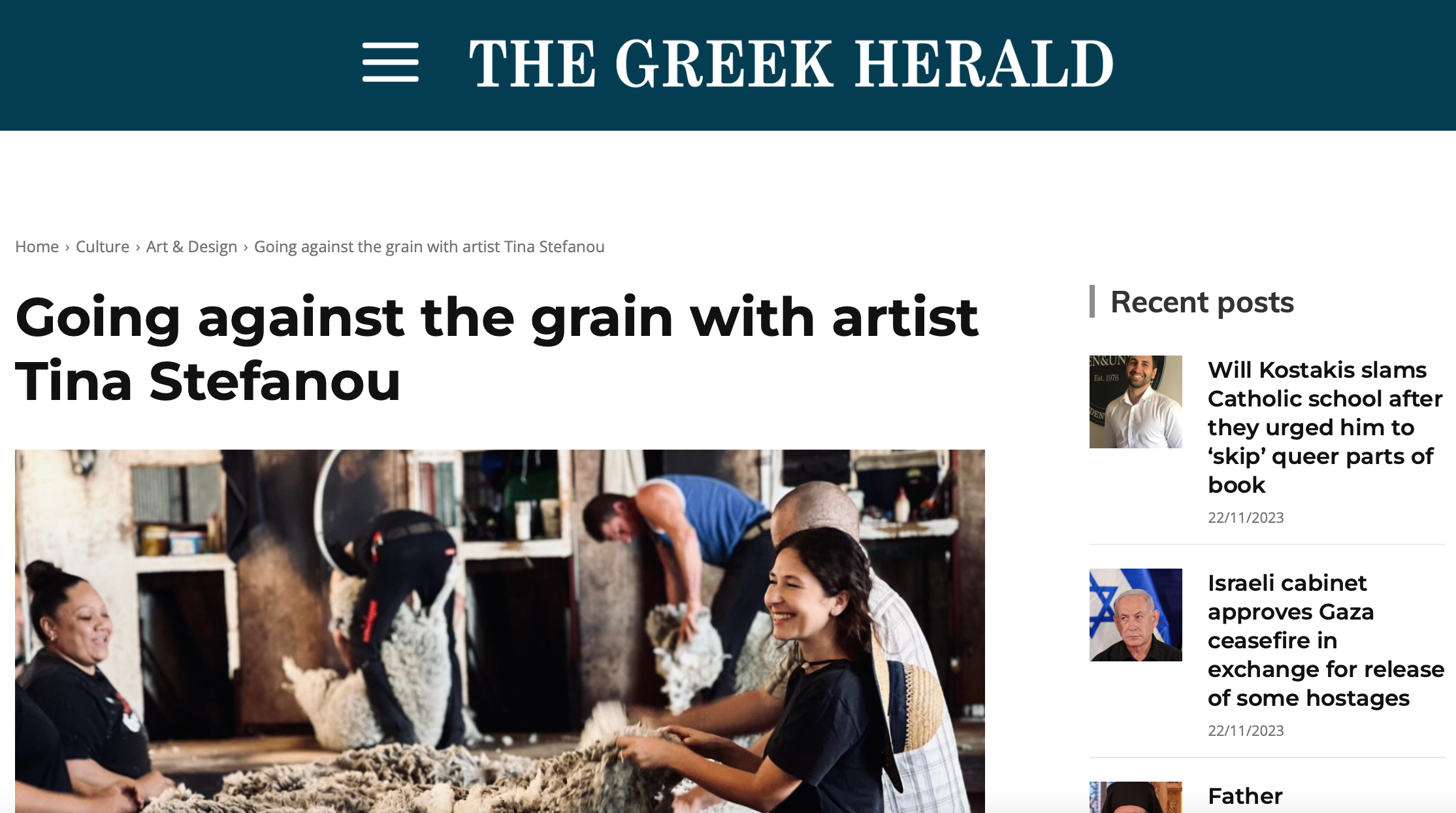
By Marianna Alepidis.
Tina Stefanou is one of 24 artists who have been announced as part of the 18th Adelaide Biennial of Australian Art: Inner Sanctum taking place in 2024.
About an hour away from the city of Melbourne, the award-winning artist lives in her own little “Greek village.” She is surrounded by the serenity of her yiayia’s farm, where she resides with the rest of her family, who have had their own hand in influencing Stefanou’s path.
“As a child, I was nourished. I had aunties and uncles that were making little films with me, my dad sang and played guitar at a Greek tavern, my mum is very expressive, even though she didn’t get the opportunity to realise that in the arts,” she told The Greek Herald.
“The way in which my family sings songs and the natural performative gestures that flow from being together, has really shaped me.
“The migrant interpretation and experience of the Australian landscape mixed with village peasant concepts such as ‘the evil eye’ form these very strange and hybrid magical forms of expression. Orientations that float around the psyche have probably been more pivotal in my development as an artist than any kind of singular human or artistic practice.”