
Automatopoeia: From The Sludge
Fieldnotes from the 2022 Art and Ecology Residency at the Dookie Robotic Dairy Farm, Agricultural Campus and the Mansfield High School.
Moving methane, BEEP!
Slobbering boundaries, ZING!
The chugg, the belch of the milky way, as it moves from my teat to your gut.
SPLASH! CRACK!
I am bovine, I am a larger field, a happening. Neither sexed nor mother.
THUD!
Neither subject, lens, tongue, or mirror.
In the words of Doja Cat, BITCH! I am a Cow.1
Grazing on cattle time: eighteen days on site is not enough time to truly form a body of work that can speak beyond the politics of capture (to be seen seeing). So, what amount of time would be necessary in a robotic dairy farm?
Vocalising, moving, writing, line dancing, listening; conversing with cows, robots, farm workers, scientists, shearers, sheep, pulses, The Quarry, students, retirees, horses and teenagers on the spectrum has generated something more-than and less-than-productive. The residency began when I hummed softly to the cows as they were being art(ificially) inseminated. In that moment, vocality assumed a quiet cinematic quality, capable of co-shaping a projected sonic environment—a multi-sensory glimpse of breath-light, sonorous-tactility, and (e)motion.
An unrestricted sociality presented itself and it was in that moment when something, which exceeds speech, whispered in my ear, sidling.2 A devotional diffractive practice; an approach to moving and being moved with the world, which takes a non-discursive route away from forward-facing representationalism. Sidling, involves crisscrossing through a plethora of (extra)ordinary encounters and entities, singing with the gaps. It refrains from an act of knowing, an approach that places the human at the apex of knowledge, which relegates the environment to an instrument of human-animal use.3 Sidling box-weaves away from a human/artist-centric paradigm—‘a sphere encompassing thought, action, belief, desire, and an imaginary economy—that is toxic.’4
This orientation prompted a challenging inquiry: amidst the mechanised monotony of a robotic dairy farm, where does fugitivity reside? Fugitivity, ‘is a desire for and a spirit of escape and transgression of the proper and the proposed.’5 In the case of the artist, it is a space that demands an attunement to voice, ‘not as individuation, but as something amidst an intense engagement with everything: with all the voices that you’ve ever heard, where you struggle somehow to make a difference, so to speak, within that voice. And that difference isn’t necessarily about you {as an artist}’6
Here the invitation is to drop the outcome, to listen fugitively and commune with sludge.
SLAP!
Sludge: a group of cow bodies on heat communing in an orgy. Messy hot rubbing. A group-soothing moment, where hooves, fur, and reproductive surfaces take part in a ritual of Bos Taurean stimming. Perhaps this is where the fugitive lives? Amidst the mire, briefly moving away from the architectures of order. The droning, trance-like sounds of milk and its mechanic corporeality resonate through the farm; this place is Automatopoeic. The fieldnotes in Automatopoeia act as a behind the scenes hyperspace, a precursor to a body of actions yet to come, presented in a moving 3D animated landscape.
The animated work, plays with ‘animatic (dis)entanglement’, an approach to animal cinematics that interrogates the historical and contemporary ethnographic methods of capture inherent in film and art making. I invite the human-animal reader to experience these processual interiorities as they are felt to me at the time. With little editing, what I experienced at the robotic dairy farm and the ecology of interactions that unravelled was a call to find another locomotion, a sidling depiction of the performative. To animate the otherwise representative disconnect between the subjugated labour of animals, and a human’s capacity to ‘assert dominion through the act of assigning meaning.’7
As Jacob Lingren writes, ‘{i}n this prevailing context, animal life is frequently diminished to mere economic units, their worth gauged by their capacity to be produced and consumed.’8 Animal life is leveraged through agricultural mechanisms, which fuels the momentum behind early time-motion technologies, trapping them within humanist hierarchies that domesticate the movement and function of bodies.9 These factors highlight an embedded habitus that centres human mastery in conventional artistic identities and environments. I find myself moving further into a para-ethnographical practice often stationed in regional and rural places, at times funded by art, government, and academic institutions. The implicit danger of an imperial narrative lies in the belief that one must placate an external figure, whether a bureaucratic or artistic institution, that sits outside of and detached from corporeal intricacies:10
lactic commoning
microbial co-composing
hormonal drifts
fatty assemblages
neural throbbing
sperm work
faecal aroma(n)tics
nervous system mastications
Motion. Capture. Cash. Cow.
CLUNK!
Over the course of ten years, deeply engaged in working and living with animals—particularly horse-kind, the original life-action-view (zoopraxiscopic) actors—I have continued to wrestle with these questions. I loop back to the ways we frame, the spaces we bring to light, the tools we use, the time we tend, the where—the places we land and the how and why we feature the voices we employ are fundamentally important. It is in this realm that an act of refusal emerges, countering the instrumentalisation of cow-labour for artwork. Sidling explores the potential of written, visual, and aural refusal as forms of sensate more-than-human sovereignty. What Dylan Robison outlines in Hungry Listening as actions of structural refusal to 'convey knowledge and experience otherwise to the normative strictures.'11 A place to instigate reflection on the production and circulation of content.
We all inhabit and co-create worlds saturated with unease, progressively mechanised, and estranged in this twenty-first-century technoscape. The aristocratic menagerie highlighted animals and their intriguing potential to signify status, a display that underscores a manifestation of imperialism and elitism stemming from the colonial cabinets of curiosity. This legacy lingers within the confines of the white cube. I can hear Bayo Akómoláfé’s assertion, ‘{e}thics is what comes to matter and what comes to be excluded in the mattering of what comes to matter.’12
It is in these tricky matters that animalness comes into relation differently, shape-shifting ethico-aesthetic landscapes, demanding ‘ontological mutiny.’13 The dynamics of pushing and pulling, the friction and the kinetic movements within the sludge, a forbidden love, the fugitive, all contribute to a sense of belonging that is brought to life through a commonist-interspecies-working-class-diaspora. This process involves a re-evaluation of how labour, bodies, and time can give rise to post-anthropocentric economies. Akómoláfé continues, ‘We are arousals. We are subjects of unspeakable arousals.’14 Animalness asks us to give up something. It disrupts the narrative of the cows at the Dookie farm as visual, knowledge, or entertainment production sites to dis-art, an inverted tonality, a place of uneasy making-wit(h)ness, dancing the war of proximity.
CRUNCH!
Notes
1. Doja Cat, “Mooo!”, YouTube, August 11, 2018, music video, 4:42, https://www.youtube.com/watch?v=mXnJqYwebF8
2. Akómoláfé, Báyò, “on Ontological Mutiny,” July 3, 2023, in For the Wild interview, with Ayana Young, podcast, MP3 audio, 01:01:50, http://forthewild.world/listen/dr-bayo-akomolafe-on-ontological-mutiny-338
3. ibid
4. ibid
5. David S. Wallace, “Fred Moten’s Radical Critique of the Present” The New Yorker, published April 30, 2018, https://www.newyorker.com/culture/persons-of-interest/fred-motens-radical-critique-of-the-present
6. ibid
7. Jacob Lingren, “Toward a Non-human Lens,” Are.na Editorial (blog), 1/08/2023, www.are.na
8. ibid
9. Lingren, “Toward a Non-human Lens,”
10. Akómoláfé, “on Ontological Mutiny”
11. In Dylan Robison's book "Hungry Listening," the author explores various forms of Indigenous knowledge sovereignty through acts of refusal, spanning aesthetics, modalities, and audiences, aimed at obstructing the extraction and instrumentalisation of Indigenous knowledge. This perspective aligns with repositioning animality within decolonial thought. Dylan Robison, Hungry Listening: Resonant Theory for Indigenous Sound Studies, (Minneapolis: University of Minnesota press, 2020), 24.
12. Akómoláfé, “on Ontological Mutiny”
13. ibid
14. ibid
Author/s: Tina Stefanou
Credits: Automatopoeia, single-channel 3D animation, moving fieldnotes, two channel sound and iPhone field recordings from Dookie Robotic Dairy Farm, 17:22 mins.
Concept and direction: Tina Stefanou. Video animation and design: Henry Lai-Pyne


Cups, 2023
Two and a half hour participatory performance for the Collective Polyphony Festival at Stockroom Gallery, Kyneton. Part of In-Kind Collectives group show.
Let me make you a cup of Greek coffee and read your creative future. Will you get that next grant? Will you finally do that painting? Are you going to take on more study? Will you finally get secure employment? Will you be invited into a big show? Together we will delve into peasant reading practices in the form of Greek coffee divination. Using metabolic processes of consumption and co-constitutional forces, I will sit with people one on one to navigate otherwise the abstractions of neoliberal art-making-it.
The vessels themselves have been made by the wonderful @corinna_berndt and over two hours I invite the public to drink, sit and read caffeinated imagery with me. In a hope to make legible the illegiblity of art futures. The action is set amongst comrades In-Kind Collective as part of @collective_polyphony_festival at @stockroomkyneton on the 2nd of Sept 6pm.
Photos by Astrid Mulder
Curator Sarah Rudledge


Rural Utopias Residency: Tina Stefanou in Carnamah #6

AUDIO TRANSCRIPT
Mixed field notes from Amangu country, read from Crete, February 17 to March 30, 2023.
Back in Carnamah. Tired body. Grief gut. Neat streets after a searing hot day. Sweat builds, even under air-con bed. No performance here, just secretions.
Walking when the golden hours sings:
ping…dab…ba…summer seed, green shimmer purple…
a granular quiet, so much industry standing still.
The grain of this land intoxicating and laced with old hungry gods.
Out here in the face of mono crops, city CV inflation, agribusiness writing, and, reading begin to collapse[1]
*Silent silos
The relentless heat of a Western Australian summer insistently disrupts the writing of these field notes, provoking a question that smoulders at the back of my throat. My time here necessitates a peculiar merger, weaving my work with the cultural artefacts of the Art Gallery of Western Australia an imperative for the future exhibition.
But what can the treasure trove bring to the table? And how can the socialities of this place, transform the Art Gallery of Western Australia's State collection?
Inspired by Denise Ferreira da Silva's poet(h)ics, I propose a move away from typical constraints. Her approach urges us to liberate these encounters from the shackles of representation, and the legal and economic structures that rigidly maintain them. It contests the established practice of the Artist as a voice giver to: objects, locations, people, systems and beings, within a collection generating foreseeable or incidental, pastural or social connections.[2]
*A heavy ball drops on artificial lawn at Carnamah long balls club.
The agri aspect of agripoet(h)ics operates on dual levels. Firstly, it recognises the agricultural dimensions that shape our lives, codes, practices, and historicity, as well as the structural formations associated with value, statehood, globalisation and production. Secondly, it seeks to aggregate adjacently and agitate surreally those tendencies that govern selfhood across various realms of existence.
Commodities, like grain under this light, are not merely secondary products of social structures or methods of production, destined to be consumed or replaced by capital, instead, agripoet(h)ics reveals the inherent significance of relations in process, in motion, and “if tuned carefully, can become robust enough to grow and proliferate, proliferate through and beyond the institution.”[3]
Just as Roland Barthes famous, The Grain of the Voice[4], moves beyond discursive language — grain, identity, and wool represent aspects that exceed market relations, opening the space for the “reevaluation of value.”[5]

Rural Utopias Residency: Tina Stefanou in Carnamah #5

March 1st, 2023:
"I'm not suicidal, I'm homicidal," declares a man wearing a cochlear implant as he plonks himself opposite me. We are both savouring our medium-rare steaks on a Wednesday night at Carnamah Pub. Even the axolotls in the corner seem slightly unsettled by his remark. I relax into my body, trying not to invoke thoughts of the Australian Gothic. Shane, who openly identifies as a 'shit kicker', spends long days on farms digging holes for soil testing. Initially, he had difficulty understanding me, but as the meal progressed, he no longer needed me to repeat myself. His blue eyes and weathered skin are marked with countless stories. An ex-army veteran, now dealing with PTSD, he prefers working alone, enabling him to vent his violent moods without causing harm to others. In many ways, he reminds me of my cousin Nick, a closet philosopher dressed in Hi-Viz.
Rural Utopias Residency: Tina Stefanou in Carnamah #4
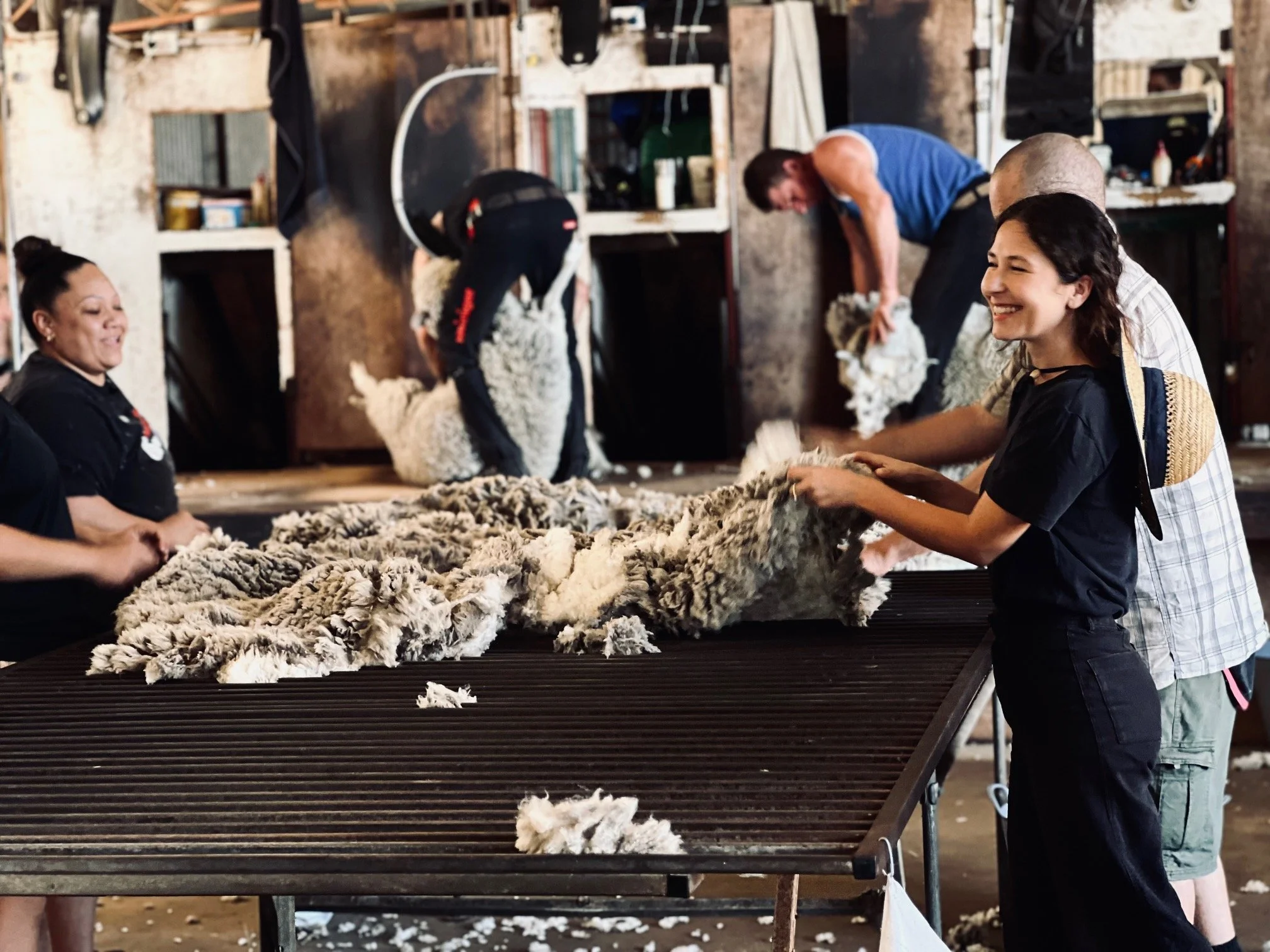
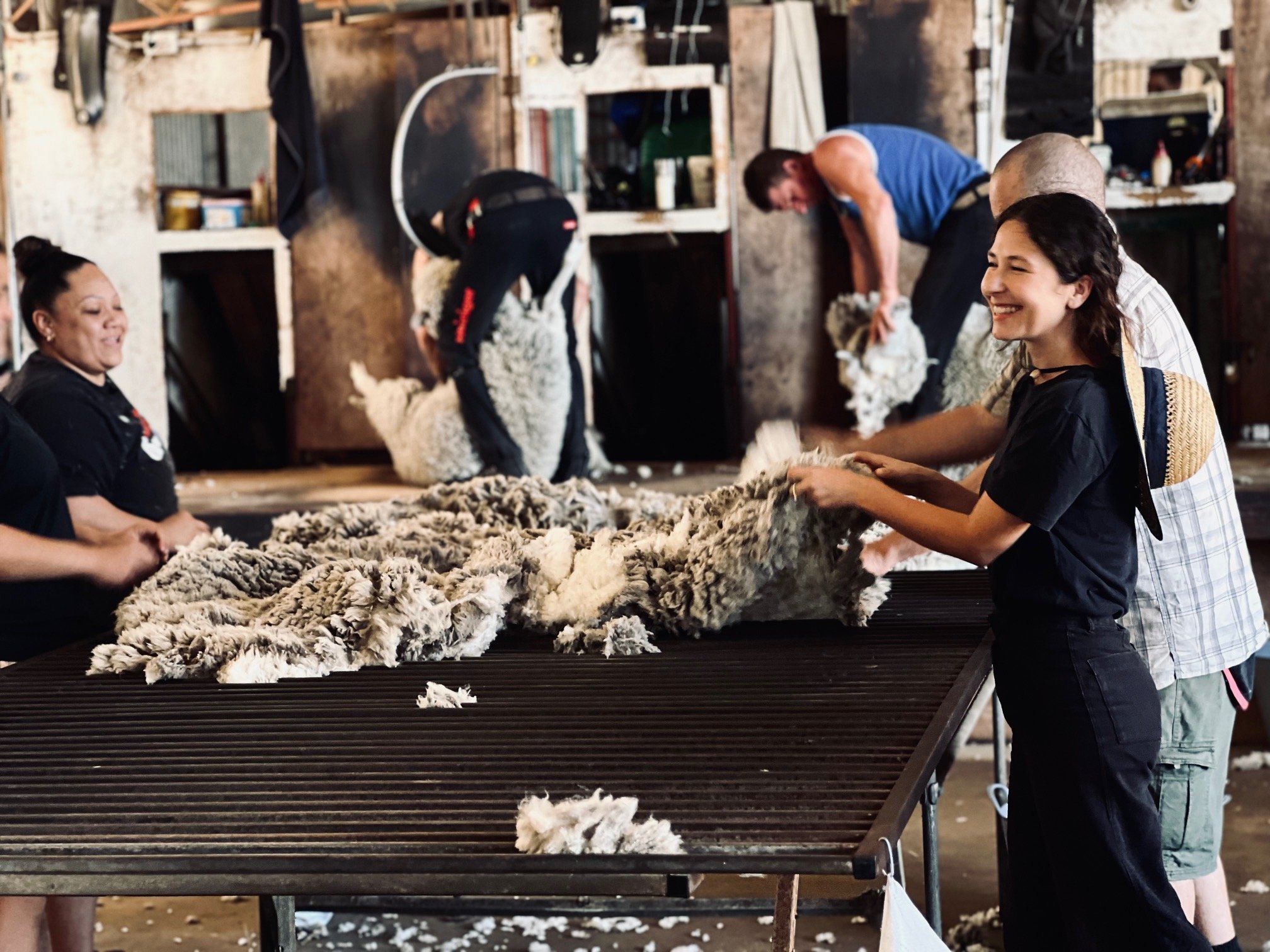
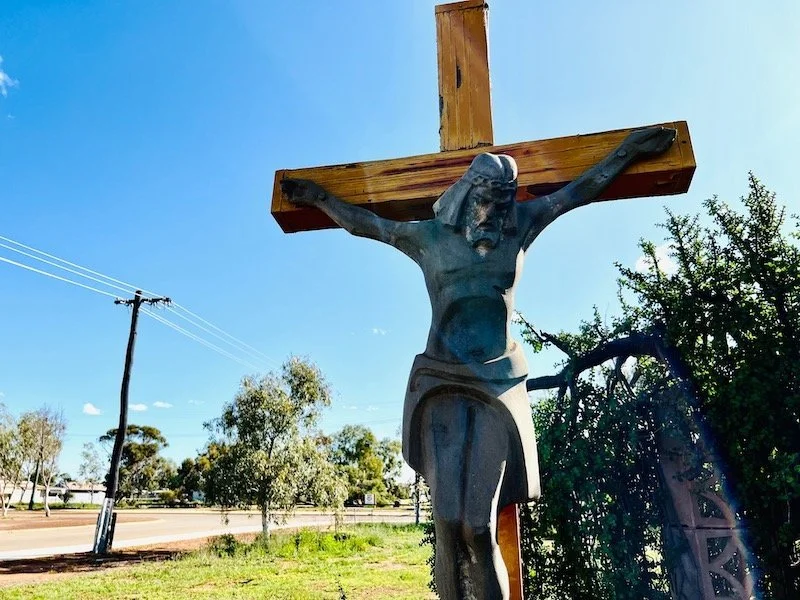
Dags, skin, and wool surround us and I feel a sense of bodily discomfort, as my nose begins to twitch and my eyes water. The image of a Madonna crying over the body of a lamb conjures a sense of mourning, a lament for the paradox inflicted upon these gentle creatures.
Open studio in Carnamah: Building a collective skin for the agribusiness dag.



Undisciplined Socialities and other offcuts
Bulletin Issue 71 (December 2022)
Bulletin Issue 71 is now available for download!
This issue was brought together by guest editor Tina Stefanou and features Kristina Susnjara, Juundaal Strang-Yettica, Selena de Carvalho, Kat Gaynor, Meera Rai and Lisa Salvo.
Contributors were invited to express what they want, without the constraint of any specific discourse or theme. The contents are undisciplined snapshots of people’s inner worlds and processes. As Tina notes, "Not a bouquet dominated by blossoms of rhetoric or a single demographic, but an offering of moments, from childhood musings to religious satire."
Issue 71 also plays with the structure of a publication—the editorial and colophon are tucked away in the middle, page numbers are removed and the front cover graces the front and the back. Dip in anywhere you like!
Link here: www.womensartregister.org/s/Bulletin_Issue-71_December-22_FA_Digital.pdf


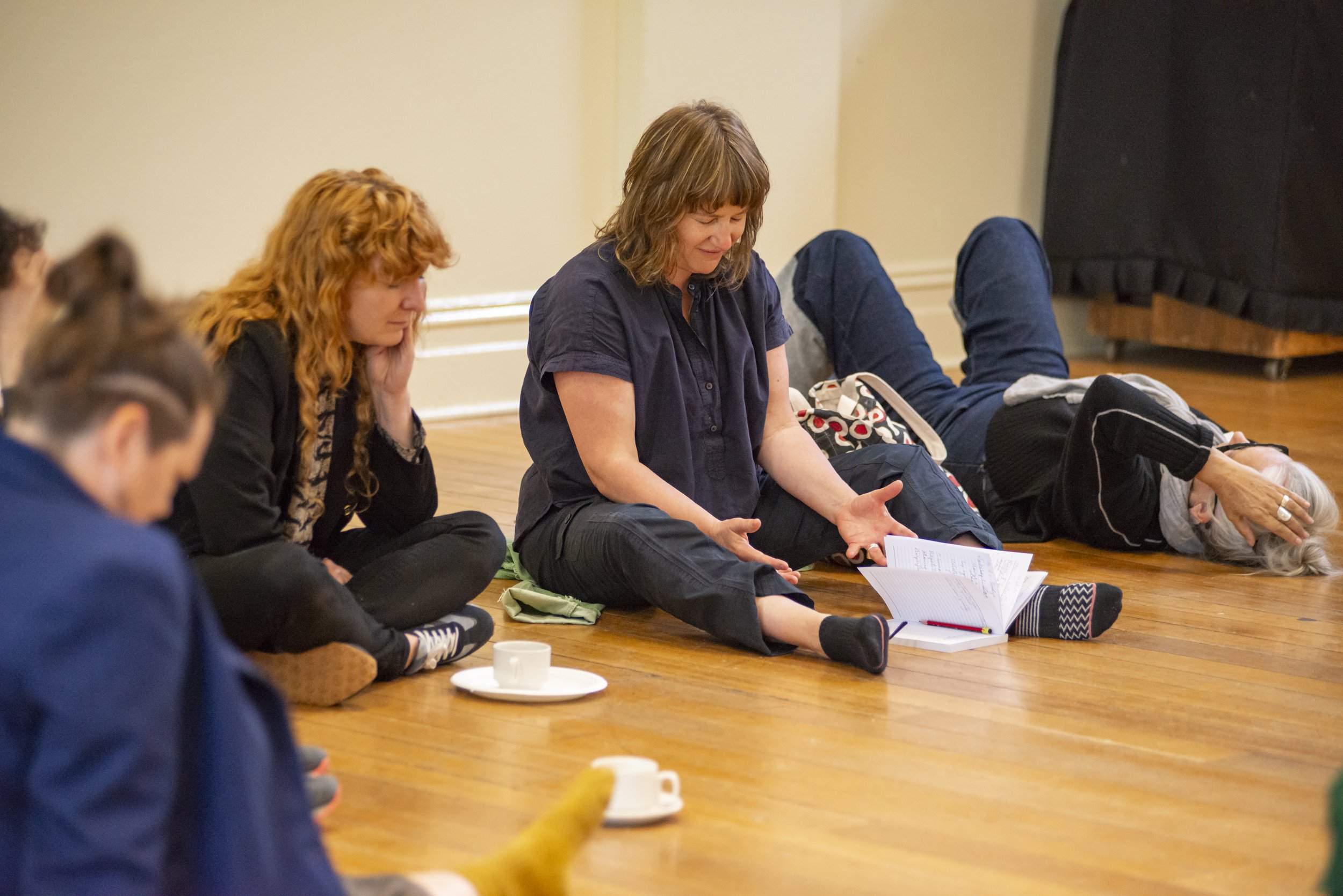
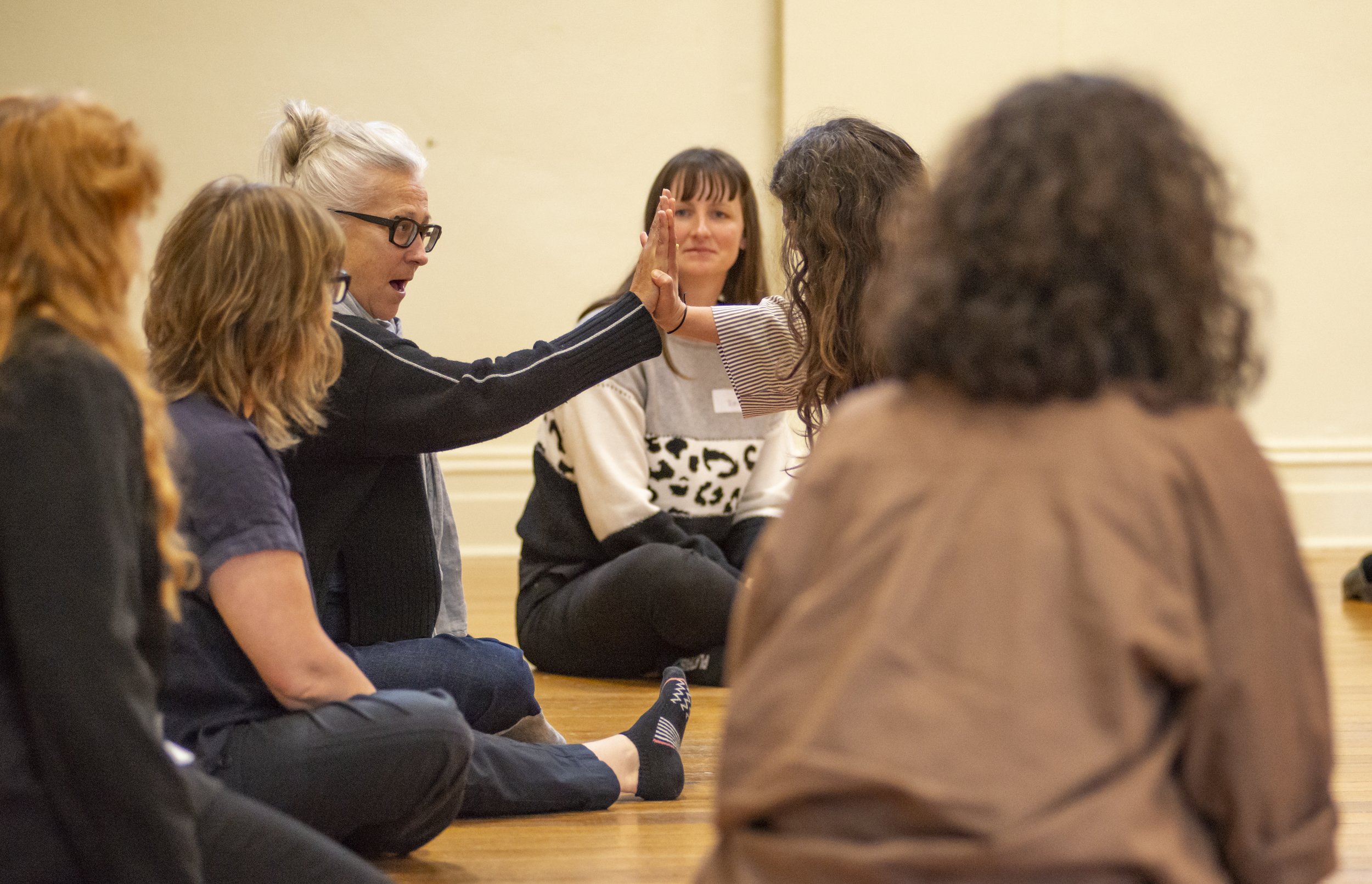
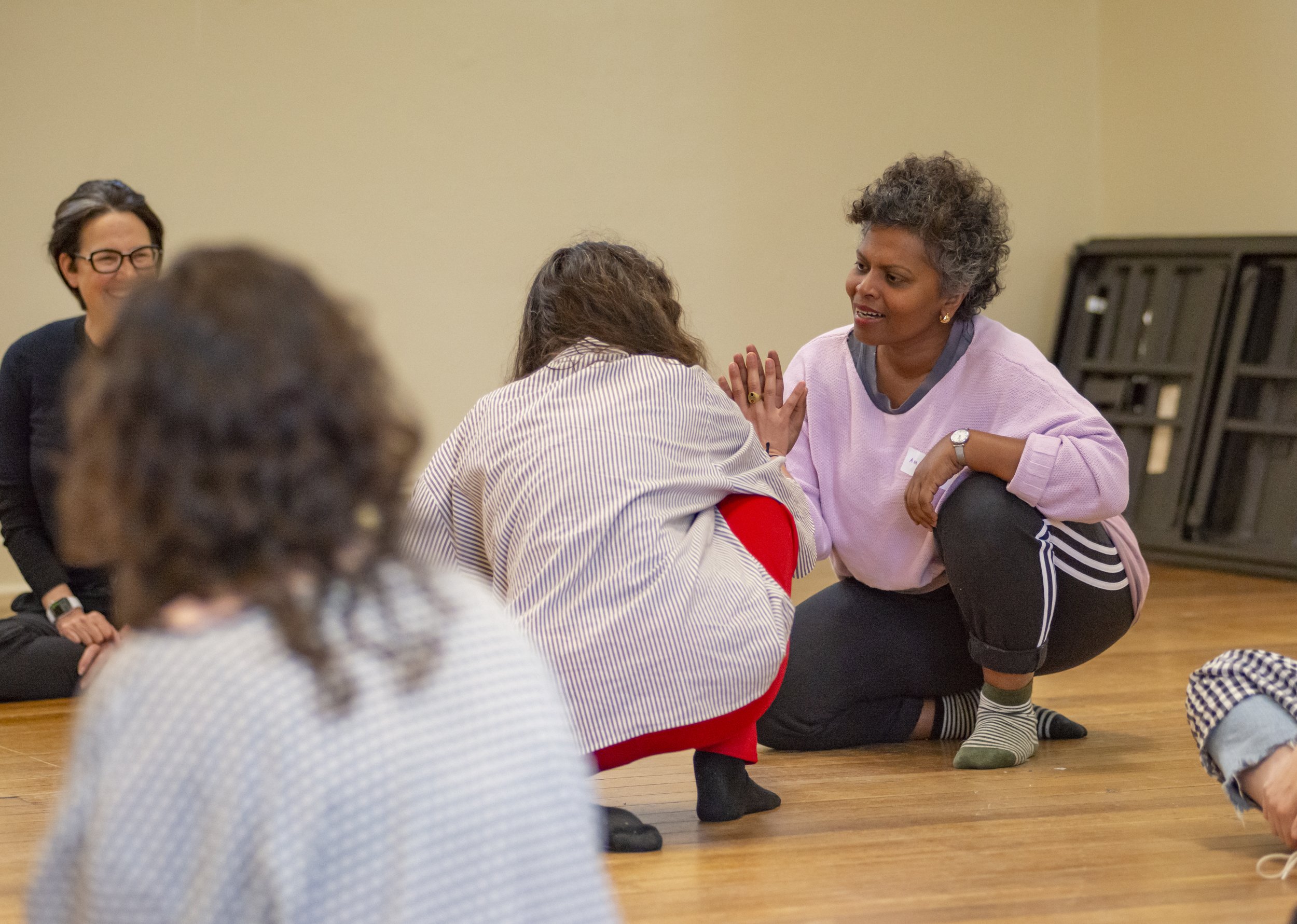
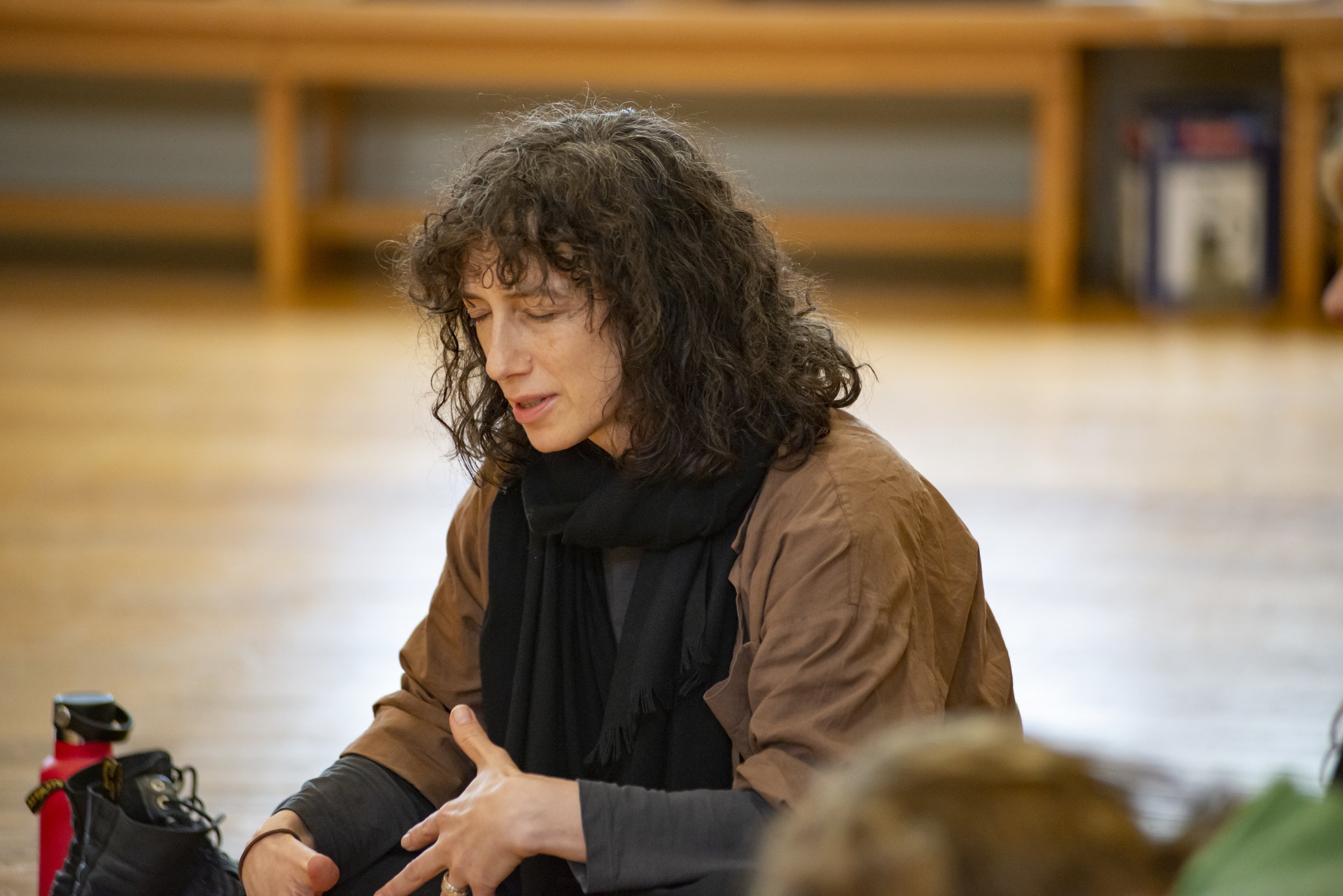
Undisciplined Voices (Workshop for Hi-Viz Satellites with Chamber Made and Punctum Inc)
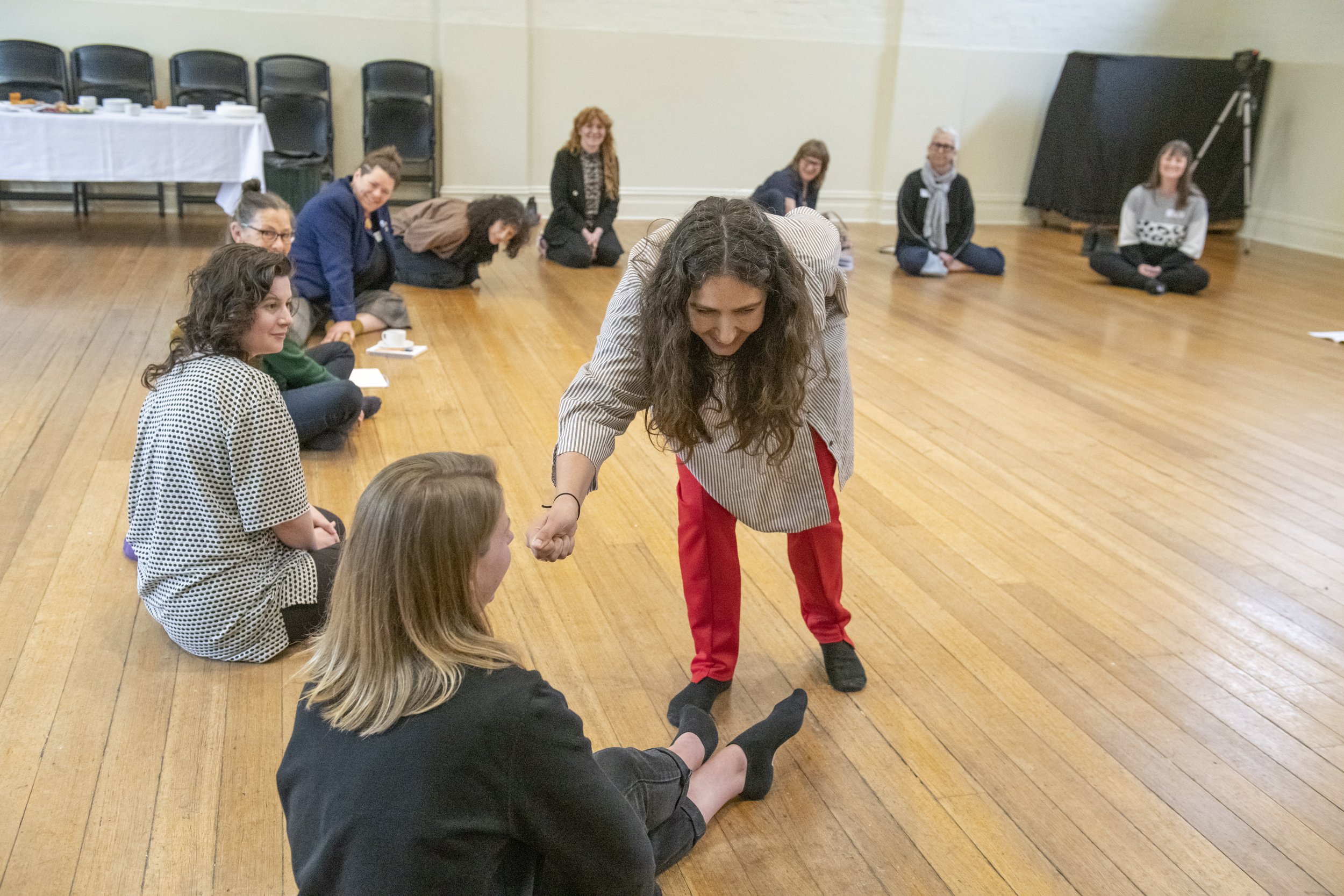
On the 19th of November, I was invited to host a workshop for the 2022 Hi-Viz program with Chamber Made, Punctum Inc and SAtheCollective. This event was taking place simultaneously across two locations in Bendigo and Singapore.
My proposition was: That we undress our practices together, to find a place of integrity and ease in our voices when we speak about what we do, how we do it and what comes next. Moving beyond professionalism or industry speak. How can we talk, act, sing, and move our practices into a planetary dimension? Which is always a collective project. How can the voice support that?
Documentation by photographer Diana Domonkos.








Hym(e)nals
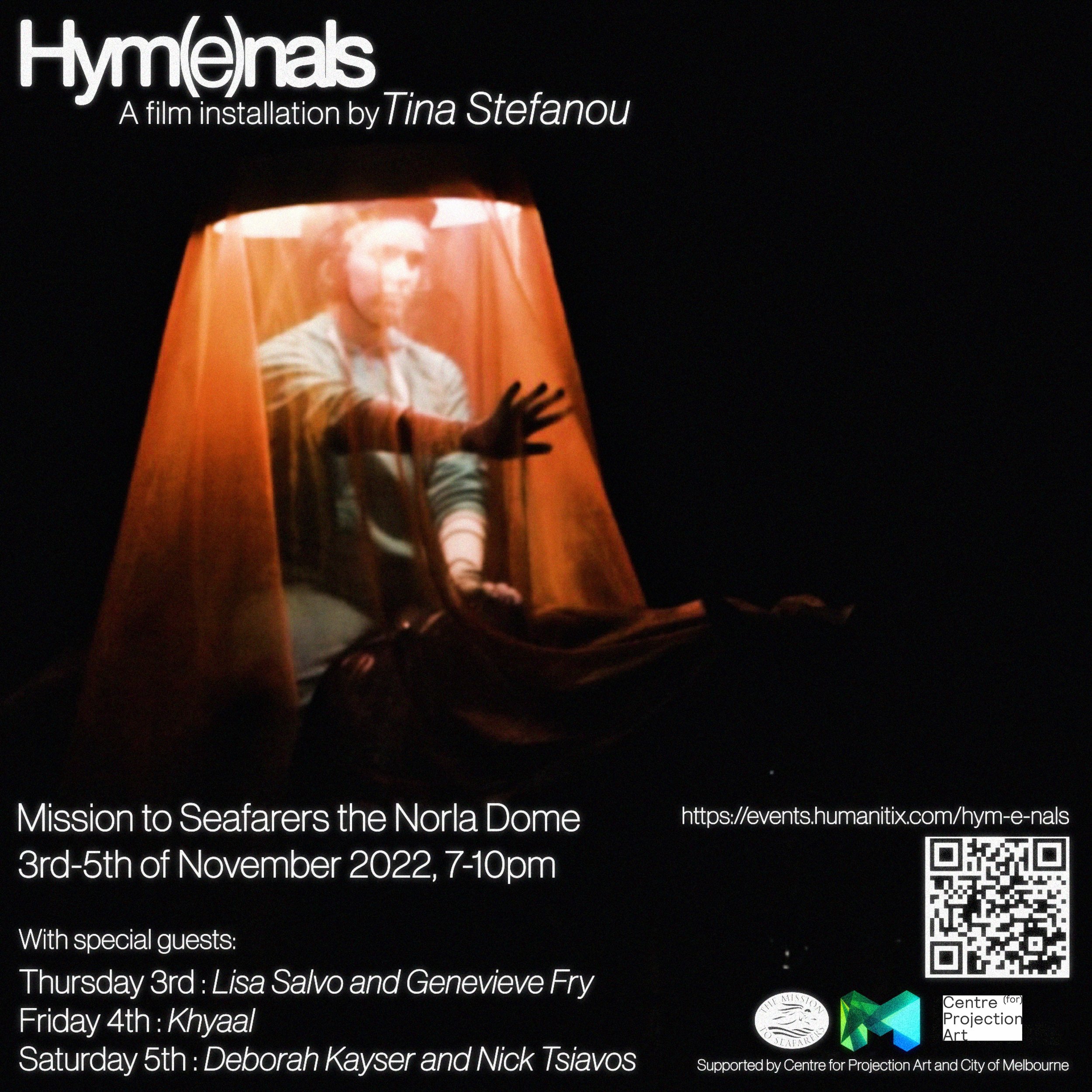
Multi-Channel Immersive Equine Film and Sound Work ‘Hym(e)nals’ Debuts Melbourne Cup Week.
An imaginative counterpoint to the competitive sport 3rd-5th November at Mission to Seafarers.
Hym(e)nals is a new multi-channel immersive film and sound work by Greek-Australian sonic and visual artist Tina Stefanou, featuring six teenage female horse riders and their elderly equine companions. Premiering on the week of the Melbourne Cup from Thursday 3rd November till Saturday 5th November, the work will be projected on the Norla Dome ceiling at Mission To Seafarers, accompanied with live musical performances each night. Hym(e)nals both mimics and challenges themes in religious paintings, speaking to local ecologies and communities as well as current global events of female solidarity and equality, collective strength, and interspecies communication.
tickets at: https://events.humanitix.com/hym-e-nals


Field noting with Lou Cole and Tina Stefanou. August-Sept, 2022
Rural Utopias Residency: Tina Stefanou in Carnamah #1
Tina Stefanou is currently working with the community of Carnamah. This residency forms part of one of Spaced’s current programs, Rural Utopias.
Here, Tina shares an update from Carnamah.
Field noting with Lou Cole and Tina Stefanou. August-Sept, 2022:
Driving on red gravel roads in the Wild Flower West, Lou an emerging community-arts producer and Tina an emerging artist connect over living in fibro homes, family stories of factory work, and the murky waters of large-scale farming. They are also soaking up the temporary power of wildflowers, only grown in this region; these rare minor blooms provide relief from agribusiness landscapes. The following is a loose bundle of reflections and stories.
*the car radio is quietly playing commentary from New Zealand
Lou: Look look! Over there! A small splash of colour amongst the small native bush. It’s a Donkey Orchid! It’s only taken me ten years to finally see a wildflower!
Arriving in the North Midlands, the majority of my work has been seasonal, and heavily linked to farming (shearing sheds in particular) and agriculture.
Rise before the sun
Prepare a decent lunch, and carry water
Long days of fresh air and seductive rays
The never-ending waving of arms
“Shoofly!”
Return at dark again
I always make sure I know how far I am from the nearest shop just in case I get a chance to pick up and refresh the stocks.
As long as I keep a decent supply of:
Noodles
Canned tuna
Tea bags
Long-life milk
When you are so far away from so-called “civilization” most other things are a luxury.
When I first encountered the wildflowers, I thought I was looking at snow. White Everlastings carpeted the ground for kilometres and kilometres. There for a moment, gone again, just as the snow evaporates.
Today, we may have taken a couple of wrong turns, but we finally found the infamous Wreath Flower. Fully formed and blooming. A small triumph.
*Tina starts clapping
Tina: How do I approach the truck divers? A local shared with me that even the small arts community space in town can feel exclusive.
*A voice appears on the two-way radio, its channel 40. “Sue, can you tell Martin to close the gate.”
Tina: Canola! Liquid gold. My eyes hurt.
Lou: The rolling burn of yellow. Money sure does grow in paddocks around here.
You should look at the statistics on how many millionaires live in this area.
How poor is poor? How rich is rich?
*Lou begins to reflect on her question as she checks the rearview mirror
Are you going without the things you normally have?
Like your phone? Food? Electricity? Internet?
Is your struggle one where you’ve got car problems?
Or not having a car? More likely, not having a license?
Is poverty affecting the way you think about money?
Have you had to make life changes to adapt to poverty?
Maybe you don’t have money, to begin with?
Each one of us takes away a different Taonga (treasure) from what we experience.
I think it is important that we take time to understand other people’s situations, and the enormity of their problems, we need to see it from their shoes or hands or eyes or ears or hooves.
*Tina nods three times
Hardships were never ending in my family, no housing, no car, no electricity, and little to no food. These were regularly occurring events growing up.
Coming to Australia is a huge cycle breaker for those of us that make the sacrifice of leaving behind all we know, and the things we love the most.
Struggling was the way we survived. It’s not easy when the average, yearly household income in your suburb is $18,000. When statistics are stacked against you, the narrative that applies to you is you’ll always be stuck in this cycle of crime, poverty, and abuse.
You put more effort into striving for excellence, always finding a solution, and you step into a state of fearlessness. You realise you have nothing to lose. The only way is forward or….
.

Babushkarism: Grandmother's Started the Revolution

Talk on the Art Smitten Podcast and SYN fm radio program with Christina Ulloa Sobarzo about the 67th Blake Prize.